Looking in my elderly copy of 'Peterson' (1974) the map for Great Bustard shows a great splash of solid red across much of Spain and Portugal. The map in the latest edition of the 'Collins Bird Guide' broadly reflects the same distribution, but, ominously, the more fashionable mauve comes in increasingly isolated blobs looking somewhat like a Roschach test card. Look more carefully and you can just see a tiny purple dot next to the strait of Gibralter. Alas, this is another example of 'field guide map' optimism. The last Great Bustard, a old, one eyed male, passed away on La Janda (once a stronghold for the species) in 2006 after many years of enforced bachelorhood. Thus the species became formally extinct in Cadiz province. La Janda is usually quoted as the last breeding site for the species in the province, but other sources suggest that the last proven breeding took place north of Jerez and towards the border with Seville province.
It was, though, surprising to read, a few months back, that the extinction of the La Janda bird meant that species was now extinct in Andalucia. Happily this is not the case and the species certainly hangs on in a number of areas in Andalucia. In fact, after decades of decline, the Spanish population is now thought to be stable overall. In some areas increases have been reported, but this is counter balanced by a continued decline in smaller isolated populations. The most recent Spanish atlas (2004) shows them to be present in Huelva, Seville, Cordoba and Jaen. That it still depicts several occupied squares in Cadiz merely underscores how quickly small populations can be lost.
It was, though, surprising to read, a few months back, that the extinction of the La Janda bird meant that species was now extinct in Andalucia. Happily this is not the case and the species certainly hangs on in a number of areas in Andalucia. In fact, after decades of decline, the Spanish population is now thought to be stable overall. In some areas increases have been reported, but this is counter balanced by a continued decline in smaller isolated populations. The most recent Spanish atlas (2004) shows them to be present in Huelva, Seville, Cordoba and Jaen. That it still depicts several occupied squares in Cadiz merely underscores how quickly small populations can be lost.
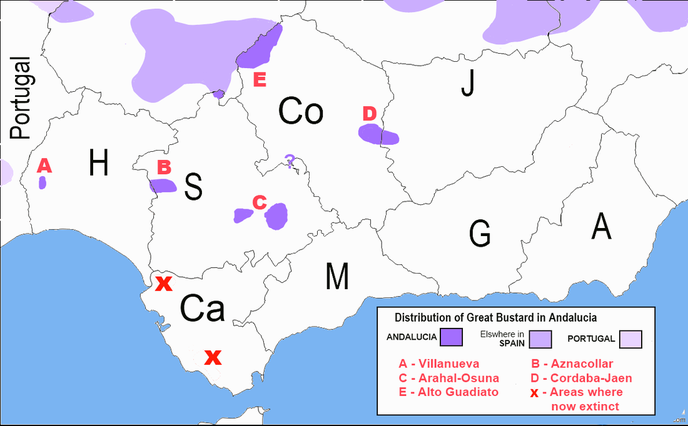
According to the most recent national survey (2003) there were no more than 350 birds in the whole of Andalucia. Leaving aside a few isolated reports, there appear to be five population centres in the region:
A - a small, isolated and seemingly declining population in eastern Huelva south of Villanueva de los Castillej
B - small population (c30 birds) north-west of Seville near Aznalcollar,
C - a larger block of occupied squares around El Arahal (c30 birds) and east towards La Lantejuela/Osuna/El Rubio
(c100 birds inc. 25 mature males)
D - a population stradling the Cordoba-Jaen border south-east of Cordoba (towards Valezuela) and into Jaen with 30+
birds south of Porcuna
E - a population along the border with Extremadura in northern Cordoba at Llanuras del Alto Guadiato (near Los
Blazquez) where there are c100 birds (with more in winter) and in the nearby Pedroches Occidentalesa (east of
Belalcazar) with c50 birds. (This population probably also spills over into Seville province north of Guadalcanal).
- With these figures the best part of a decade out of date and with smaller populations being vulnerable, it's not surprising that in Andalucia it's categorised as in 'critical danger.' Hardly surprising as less than 30% of birds survive their first year. The two populations in Huelva and western Seville (A & B) are now so small that they may not be viable in the long run (although they still seem to be reported from both areas). I don't have precise figures for the whole population in Cordoba/Jaen (D), but it appears to be rather low so it too may be endangered. Once small populations become extinct, natural recolonisation is problematical as Spanish Great Bustards are relatively sedentary (unlike eastern European populations). In Spain birds do not move much more than 20 km from their breeding sites although males may range as far as 65 km. The remaining two populations – Arahal-Osuna (C) and northern Cordoba (E) - have similar populations (100+ birds). Arguably, that in the north is the more secure as it is close to larger Extremaduran population. This is reflected by the influx of birds in the winter here which increases the population by c50%.
All the above suggests that, whilst the odd 'vagrant' may reappear in Cadiz province, recolonisation is not likely to happen anywhen soon and that some of the more isolated populations in Andalucia will gradually disappear. (For more details see http://ec.europa.eu/environment/nature/conservation/wildbirds/action_plans/docs/otis_tarda.pdf)

 RSS Feed
