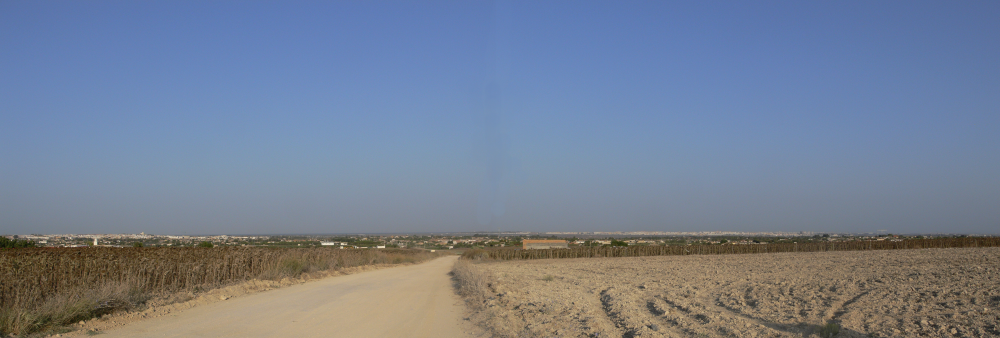
Look at any large scale map of Spain and you soon find that cañadas, which can be best be translated as droveways, crisscross the country. Some have been converted into 'proper' tarmacked roads, others remain broad tracks flanked by wide grassy margins and others have degenerated into narrow, sometimes virtually non-existent, footpaths. Their status as rights of way is often disputed or questionable (although I understand that Cañadas Real - Royal droveways - have greater legal protection). As in the UK such ancient rights of way are often under threat from rapacious landowners. Frequently they're named after the places they connect, the topography of the area or the trade using them. Cañada de Marchantes not only runs through an excellent area for birds to the Lagunas de Chiclana but also for affords superb views across this corner of Andalucia. So wide and open is the view that no single photograph can quite do it justice.
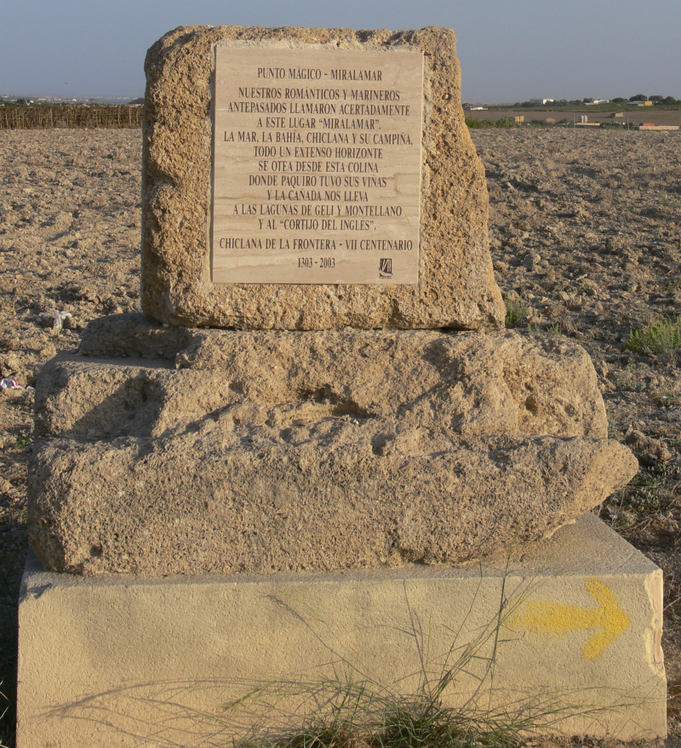
That the views here have a special place in local sentiments is clear by the name given to the mirador along the route that enjoys the most spectacular view, “Punto Mágico”. It's no coincidence that when Chiclana de la Frontera celebrated the 700th anniversary of its founding, this relatively isolated spot was chosen to memorialise the fact.
The inscription on the modest plinth reads, in translation, as follows:
Magic Point - Miralamar.
Our Romantics and seafaring forebears rightly called this place Miralamar (Sea View). The sea, the bay (of Cadiz), Chiclana and its countryside, a whole wide horizon, is viewed from this hill where Paquiro had his vines and the droveway takes us to the lagoons of Jeli and Montellano and Cortijo del Ingles. Chiclana de la Frontera VII centenary 1303 – 2003
Magic Point - Miralamar.
Our Romantics and seafaring forebears rightly called this place Miralamar (Sea View). The sea, the bay (of Cadiz), Chiclana and its countryside, a whole wide horizon, is viewed from this hill where Paquiro had his vines and the droveway takes us to the lagoons of Jeli and Montellano and Cortijo del Ingles. Chiclana de la Frontera VII centenary 1303 – 2003
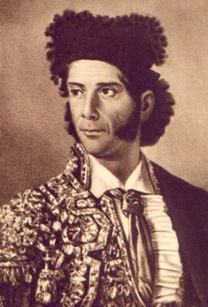 Paquiro looking every inch the 70's rock star! (Photo - Wikipedia)
 ”Paquiro” was the nickname of Francisco Montes Reina (1805 – 1851) who was born and raised in Chiclana de la Frontera (where there’s a museum in his memory). Paquiro is one of the most famous names in bullfighting history being responsible for the codification of its rules and the formalisation of the now traditional "Traje de Luz" (the toreador's colourful suit). The cap that bullfighters wear - the montera - is named in his honour (from his family name Montes). He remains revered in bullfighting circles and, whatever one may think about bullfighting, a local hero to many. As suggested by the inscription he owned vineyards in this area.
I had lazily assumed that 'Cañada de Marchantes' meant 'Droveway of the Merchants' given the proximity of a great port. However, on checking I found that, surprisingly, it actually means "Droveway of the Marchers". Marching seems the antithesis of cattle droving where the point was to get cattle to market in a good condition not as quickly as possible. Since only soldiers generally march was there a military connection of some sort? I have no evidence to prove the fact but I suspect that the answer may lie in the Peninsular War (1808 - 1814). At that time a French Napoleonic army besieged the Anglo-Spanish forces that held Cadiz. In a move to break the siege Anglo-Spanish forces were landed near Algeciras and then moved north, taking Vejer de la Frontera in the process, before meeting the French in a bloody battle just south of Sancti Petri. French forces based in Chiclana under Leval and Ruffin took part in this campaign and, looking at the map of the conflict, it's quite possible that they took this cañada to reach the battle thus providing a military context for the name. This is, of course, a speculation but not I think an entirely unreasonable one.
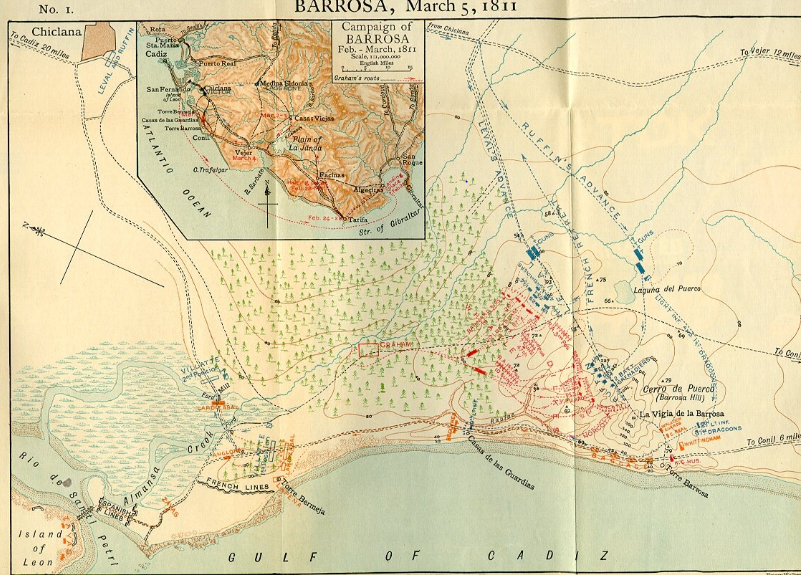
The Campaign of Barrosa - the ornithologically obsessed will note the size of the Laguna de La Janda in the inset map!
The name of the farm - Cortijo del Ingles (mentioned on the inscription may seem surprising given that the historical animosity between Spain and England found its apogee in the sacking of nearby Cadiz (by Sir Francis Drake). A farm named after the old enemy overlooking the site of their most notorious attack is superficially unexpected. Yet by bringing back 2,900 barrels of "liberated" sack (as sherry was then called) Drake unintentionally gave the English a taste for Spanish wines. This was summed up by Shakespeare when he gave his most infamous, drunkard, Falstaff the line "If I had a thousand sons the first humane principle I would teach them should be to forswear thin potations and to addict themselves to sack". In the 19th century this taste was further encouraged by British involvement, as noted above, in the Peninsular War and subsequently strong British involvement in the production of sherry (as witnessed by sherry trade houses like Osborne, Williams and Humbert). Although outside the famous "Sherry Triangle" (formed by Jerez de la Frontera, Sanlúcar de Barrameda and El Puerto de Santa María), Chiclana is within the area that produces grapes to make the drink. Hence it's not really surprising to find an "English farm" here after all.
Birds apart, one of the great joys of birdwatching is that it takes you to places that most tourists never discover and introduces you to odd snippets of culture, tradition and history to which most visitors remain oblivious.
 RSS Feed
