It's not just about birds. No, honestly, it isn't! Birds may be the prime reason for my interest in this area of Spain, but the region has plenty more to offer. The area to the south and south-east of the Arcos de la Frontera on the edge of the Alcornocales Natural Park doesn't include any outstanding sites or have any particular birds of interest. However, it remains one of my favourite areas for its attractive scenery, historical and cultural interest. Not that it doesn't also have birds to see ….
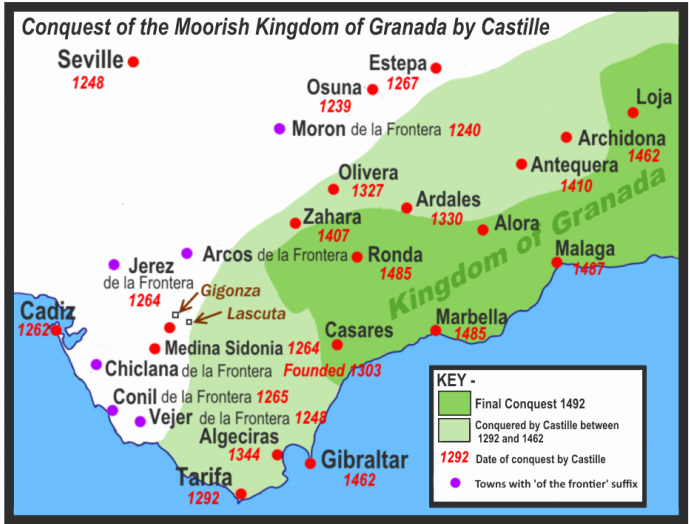
For nearly 250 years (1248-1492) this part of western Andalucia marked the boundary between Christian and Moorish Spain. The most obvious reminder of this heritage are the string of place-names that share the self explanatory suffix 'de la Frontera'. The centuries of rule by the Moors often goes unacknowledged although, if you're aware of Arabic etymology, it is traced by the place names. If you know where to look, though, there's plenty in this area to remind the visitor of its complex history.
For nearly 250 years (1248-1492) this part of western Andalucia marked the boundary between Christian and Moorish Spain. The most obvious reminder of this heritage are the string of place-names that share the self explanatory suffix 'de la Frontera'. The centuries of rule by the Moors often goes unacknowledged although, if you're aware of Arabic etymology, it is traced by the place names. If you know where to look, though, there's plenty in this area to remind the visitor of its complex history.
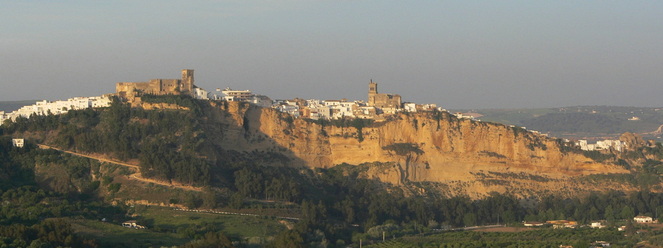 Arcos de los Frontera from the A 393
 The gem here is old town of Arcos de la Frontera which stands majestically on a sandstone hill which has been dramatically sliced apart by the Rio Guadalete. It's a pleasant place to stroll round and admire the architecture. The view from the Balcon de Arcos off the Plaza del Cabildo at the top is breathtaking, but bettered from that to be had from the church tower in the square (check locally for opening times). The castillo here is private, but was once the home of English bird artist W H Riddell who died here in 1946. Riddell was also son-in-law of Walter Buck who wrote the pioneering work 'Wild Spain' with Abel Chapman. Both had links to the sherry trade. If you want somewhere spectacular stay book a room with a terrace at El Convento just to the east of the plaza (the parador is more expensive). It's worth searching out the small 'Moorish' garden which is just beyond this hotel since it's one of the few places locally where Spain's Moorish heritage is acknowledged. It's a great place to take non-birding partners … but don't worry about withdrawal symptoms you get great views of Lesser Kestrel from the 'balcon' and, in season, migrating Black Kites, etc.
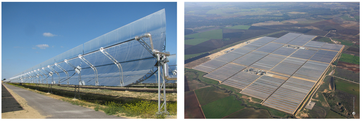
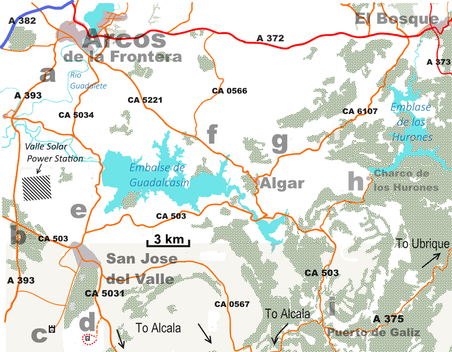
For a view of the town (a) pull off a few kilometres south along the A 393. Continuing south along the A 393 you soon pass the Valle Solar Power Station a solar thermal power station which became operational in January 2012. Unlike the familiar solar panels, huge fields of mirrored parabolic reflectors focus heat on oil filled pipes to generate electricity.
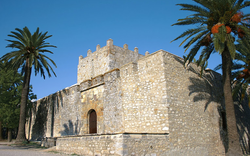 Castillo de Gigonza
 Pull off just south of the cross roads (b) with the CA 503 to explore some pleasant open cork woods (dhesa) where I've seen Hoopoe and heard Red-necked Nightjar. If by now any non-birding culture vultures are wilting by now, then some further c4 km south divert to the left along narrow roads to the remarkable Castillo de Gigonza (c). Now scarcely more than a fortified farmhouse with a watch tower – albeit a rather attractive one – this was once the site of the pre-Roman settlement of Saguntia mentioned by Livy. The town reached its zenith under the Visigoths and in the 7th century it was important enough to mint its own coins. Under Muslim rule, it changed its name to Xisgonza, but standing on the border between Christian and Muslim Spain couldn't have done much for the long term prosperity of the town which fell into decline. Not surprisingly there's scarcely anything left apart from the mediaeval castillo. In the 19th century it briefly became famous for its medicinal sulphur springs. There's not a lot to see, but its an atmospheric place and the tracks heading south towards Paterna could be tempting to explore ornithologically - those birds do keep sneaking in!
A little less than 5 km south-east from Gigonza there's a second intriguing memorial to times past, the ancient site of Lascuta (d). Since both settlements were occupied contemporaneously, there must have once been a good road between them, but today only an increasingly decayed tracks link the two directly. It'd make an interesting walk, but the easiest way to get there is to head back to San Jose and then back towards Alcala. The CA 5031 towards Alcala, then as the road drops down and swings left (after c6 km south of the junction with the CA 0567) to pull off onto a reasonable gravel track (where a helpful Spanish/English information board stands). You can walk from here, but you can reduce the walk by a couple of km by driving further along the route until a very rough track heads up the hill to the obvious tower on the horizon. The Torre de Lascuta is a remarkable survival dating from the 2nd century BC when this area was fought over by the Romans and Carthaginian. The settlement here dates from an even earlier epoch having its roots in the Chalcolithic Age ('Copper Age') of the third millennium BC. Of this ancient settlement very little, other than earthworks, remain. As you approach look out for a small Cattle Egret heronry in the valley below. Although deserted now, Lascuta has a unique place in Iberian history. It was here that a famous bronze plaque, now in the Louvre, was found in 1840; dated to 189 BC it's the earliest example of a Latin text found in Iberia. The views from here are excellent and it's well worth the walk.
The CA 5034 (e) and CA 5221 (f) both provide alternative, arguably more attractive and certainly a quieter approach to Arcos. Views across the Embalse de Guadalcasin towards the Alcornocales or Grazalema are stunning – in the UK it'd be a major tourist destination rather than a quiet backwater. The views along the southern shore on the CA 503 aren't as good since you miss the mountains reflected in the water, Naturally the embalse attracts huge numbers of swifts during migration with Common, Pallid and Alpine in good numbers and it must be worth checking for a White-rumped although picking one out will be tricky.
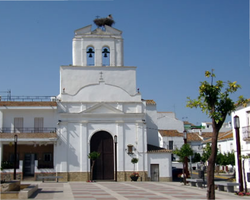 Algar Church - complete with stork's nest!
 Unlike its neighbours, which all have narrow, twisting, labyrinthine roads, the small village of Algar is built on a strict rectilinear grid. Unlike the traditional “pueblo blancos” which have Moorish origins, apart from the ruins of a small 13th century castle, Algar was created in the 18th century. One Domingo López de Carvajal, a wealthy aristocrat, from El Puerto purchased land from Jerez de la Frontera municipality in 1757 and settled 90 paupers from Bornos, Ubrique, Benacoaz and Rosario on the land in 1766. Each was given a plough team and 25 acres of land and the village was gained Royal recognition in 1773. Evidently, this was done in gratitude to the Virgin of Guadalupe whose intervention, during a tropical storm on his way home from Mexico, Caravajal credited his survival! Accordingly the village church, built in 1762, is dedicated to Santa María de Guadalupe. From Algar the CA 6107 (g) runs north-west towards El Bosque and the Grazalema Natural Park. The road's not marked on many maps and warning signs still claim it's in bad condition, but it was repaired a few years back and is now a good, if little used, road to El Bosque. It's one of my favourite routes as it runs through attractive rolling dhesa with more excellent views of Grazalema.
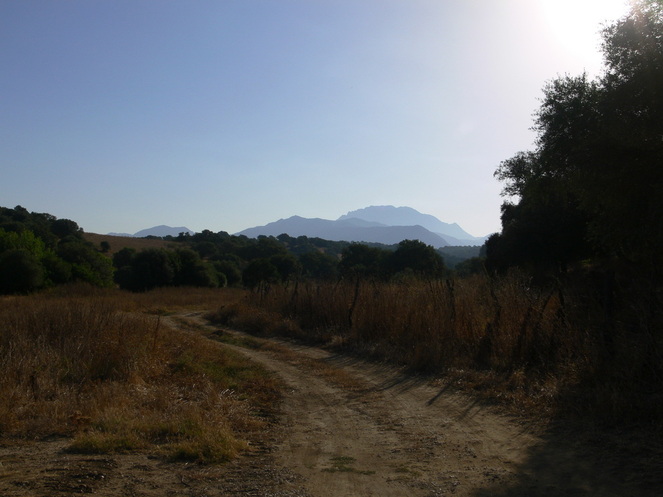
View towards Grazalema from near the CA 6107
Instead of taking the obvious route along main roads back to my base in Alcala de los Gazules from Arcos, I often take the picaresque drive along the CA 503 between Algar and Puerto de Galiz. It's a much longer and slower route, but the scenery is terrific and, if there's room, it's worth stopping at the venta at Puerto de Galiz which has an excellent local reputation for good food (esp. game). I passed the side turning signposted to the Presa los Hurones many times before I finally got round to exploring the road (h). Shaded by an avenue tall eucalyptus trees, the road heads through an open landscape with the hills kept at bay some distance from the road, but gradually the trees and hills begin to crowd in. It's this experience of finding your horizons gradually restricted that makes this drive feel more like an exploration. After about 3 km trees close in round the road which soon drops down into the valley of the Rio Majaceite. Here an abandoned 'recreation area' stands below a long straight bridge. The stream and bushes here probably deserve greater exploration than I've yet given them. The crags here often have Griffon Vultures too. Attractive though the valley may be, thus far it's just another pleasant drive. What, for me at least, makes it something special nestles into the hillside below the dam another two kilometre further on. Dropping down towards the bottom of the valley, you suddenly see before you a small hamlet that seems to combine the innocent charm of Trumpton and the promise of Shangri La with a subtle hint of menace! Built in the 1950s for the workers on the dam that towers above the village the twee 30 odd cottages, arranged in rows along the slope, look like something out of Lego-land. In it's heyday there were over a hundred inhabitants here who had the use of their own community centre and swimming pool. Not surprisingly so since when few people had cars this was a pretty remote location. Fortunately, the small bar here remains open for a drink or simple snack. The centre piece, though, is the church whose bell tower overlooks the village. Now that the population has shrunk to half a dozen or so, these facilities are in various stages decay although the gardens are always neatly trimmed and maintained. Charming though it is, it all looks just a little too neat, too controlled and, although decayed, too organised to be entirely comfortable; it would make a good location for a Spanish version of 'The Prisoner'. From the top of the dam you have good views of both the settlement and the reservoir. At the far end of the dam a flight of concrete steps take you through the woods to a concrete 'bunker' (Blackcap, Iberian Chiffchaff & Iberian Green Woodpecker are present). This must once have been quite a viewpoint, but is now almost entirely screened by trees. The overflow stream below the dam has Grey Wagtails and, according the owner of the bar, Otters – not entirely surprising perhaps since 'Charco de los Hurones' apparently means 'Pool of Ferrets'. Scan the skies for House and Crag Martins, 'Barn' and Red-rumped Swallows, Sparrowhawk, Common Kestrel, Booted and, with luck, Bonelli's Eagle. Those birds do insist in creeping in, but even for a non-birder this is a fascinating place to visit.
 RSS Feed
