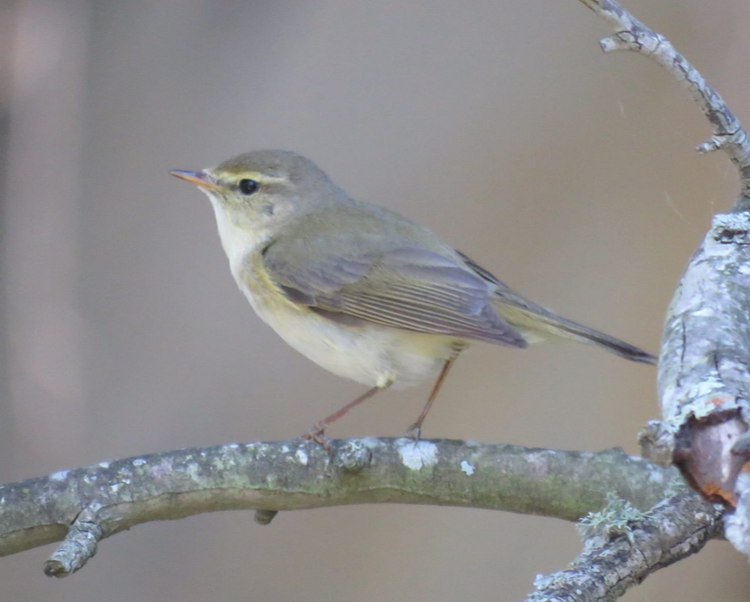
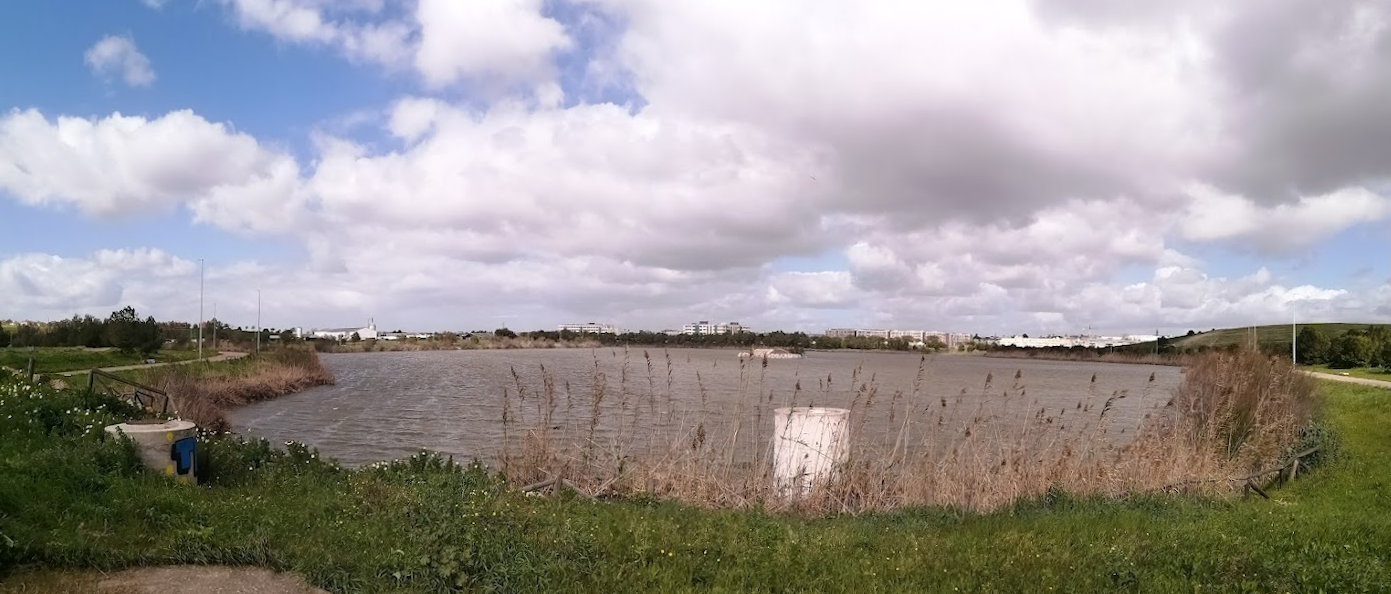
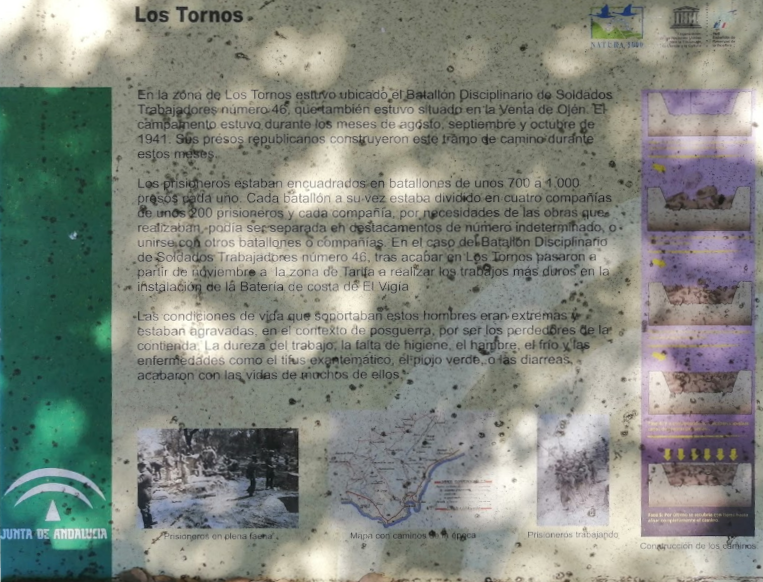
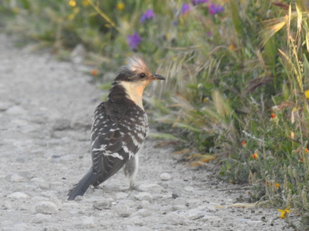
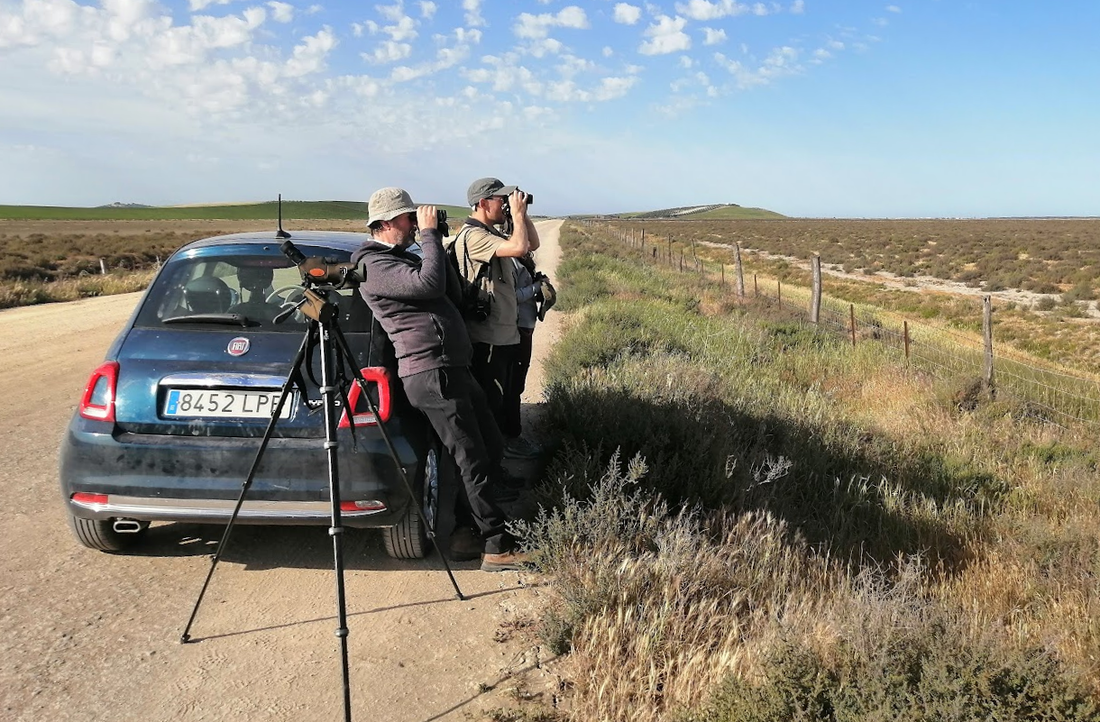
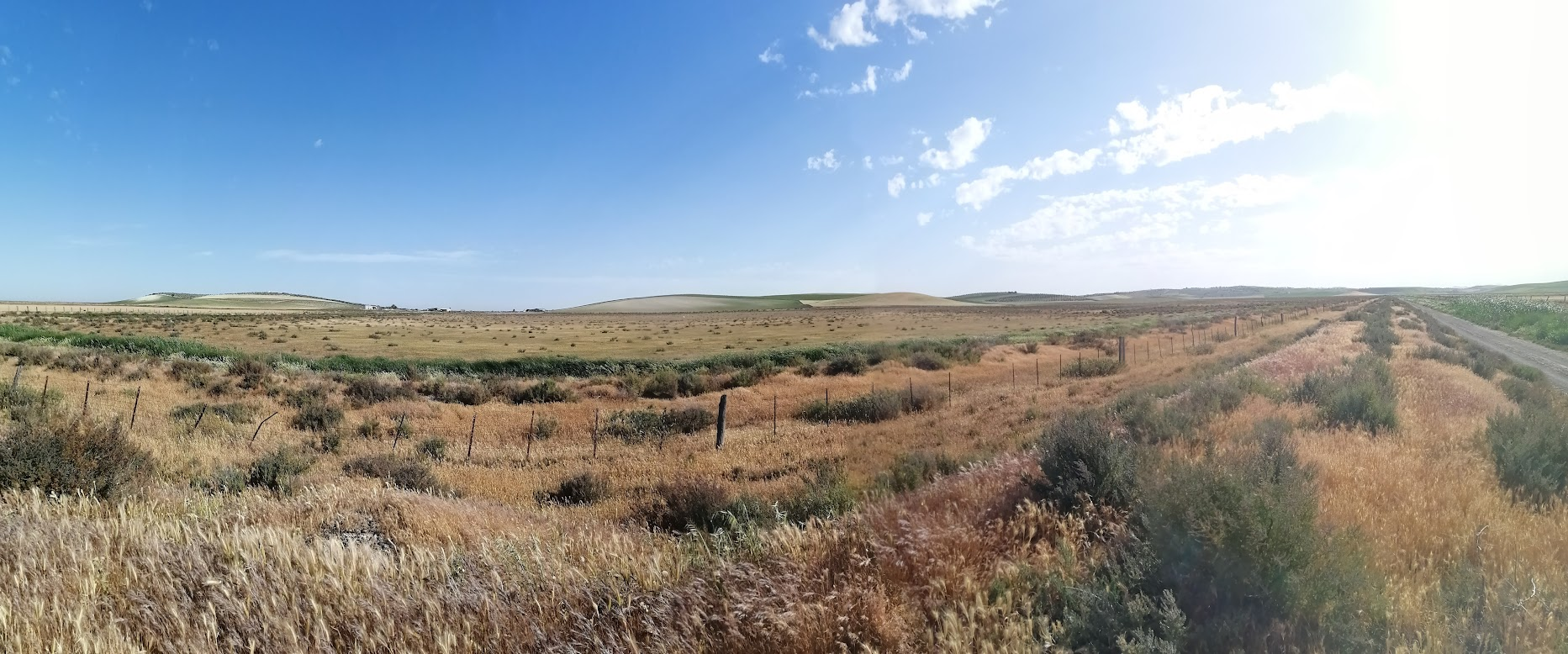
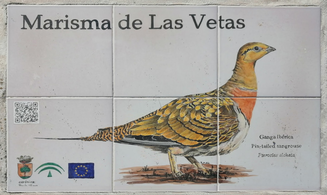
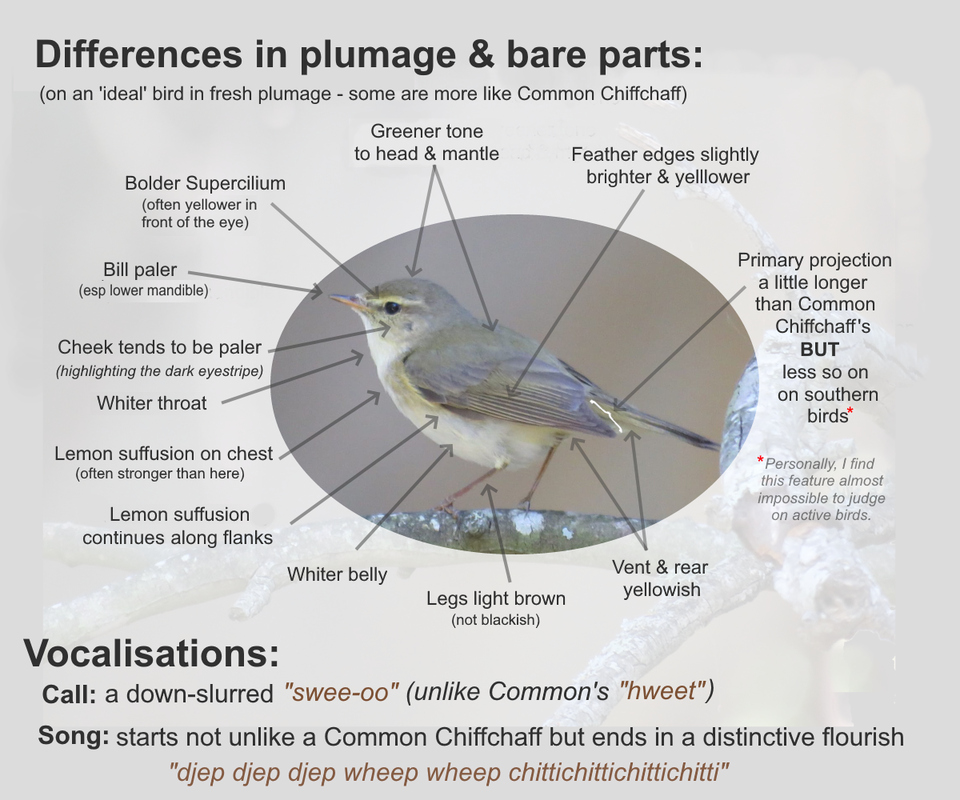
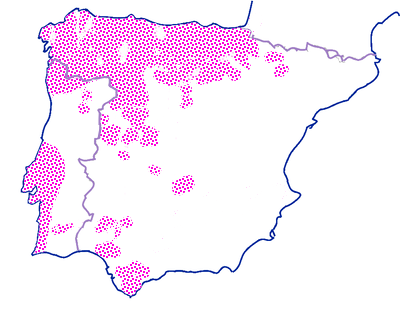
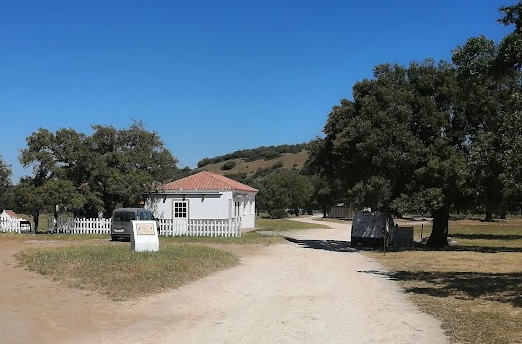
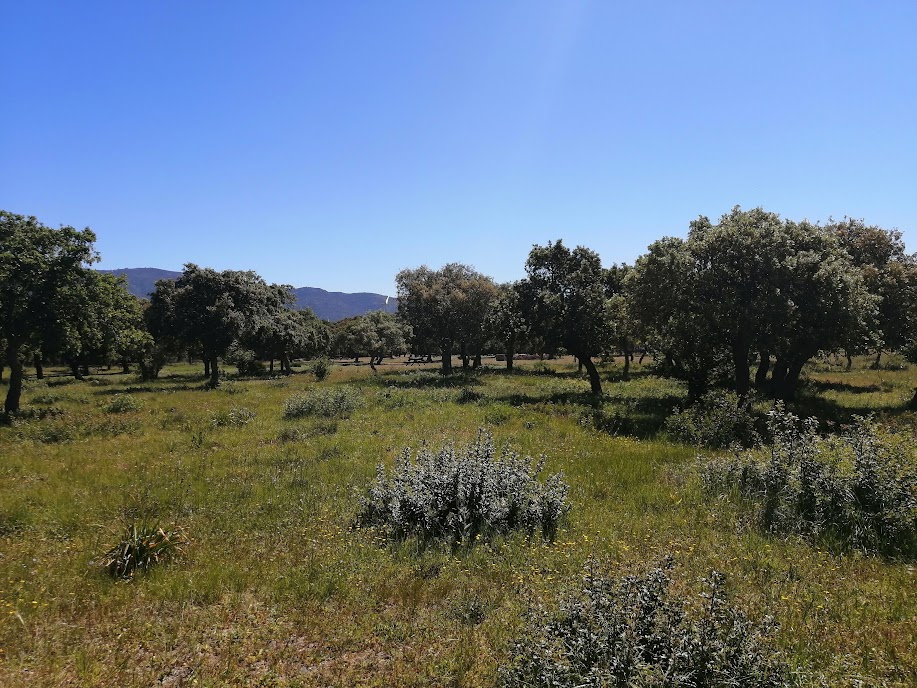
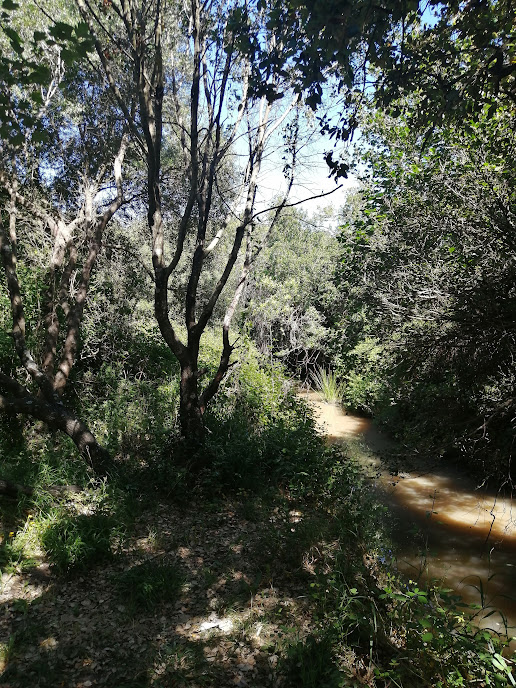
![]() Entrance to the Molinos valley from Alcala The small village of Alcalá de los Gazules sits high on a small hill above the A381 behind which looms the wooded hills and crags of the Alcornocales. As the A 2304 skirts round the village a minor road (CA 6201) strikes off to the east. This takes you down the Molinos valley to the small hamlet, and that’s a generous use of the word, of Patrite which forms a lose cluster of houses at the valley. A plan, during the earlier years Franco’s dictatorship, to push the road all the way to Jimena (c17km through the park) was mercifully abandoned thus preserving the wild landscape. This was a mercy not just for the landscape, but also for those earmarked to build it as, like many roads of that era, it was to be built by forced labour using Republican prisoners. Although close by the village, a lip at the start of the valley means that once you’re a few hundred metres along it you can see scarcely any signs of civilization lending the place a surprisingly isolated feel. ![]() Record shot of Great-spotted Cuckoo The start of the valley (a) is often a good spot to look out for Black-eared Wheatear as a pair usually breeds here. The road quickly drops down into the valley which then opens out as the road heads, arrow straight, towards Patrite. The telegraph wires here frequently provide a place for passing Bee-eaters to rest and for hunting Woodchat Shrike to use as a vantage point. In winter Woodchats may be replaced by Iberian Grey Shrike. About 3km along the road there’s a rough track (b), to your left, also bordered by telegraph wires which again provide perches for passing birds. With virtually no traffic, this is a better place to stop and look than the main road (although its hardly very busy). This is another site for breeding Black-eared Wheatear whilst I’ve also had passing Tawny Pipits and Great-spotted Cuckoos here. The whole valley seems to funnel migrants with Black and White Storks regularly passing over in good numbers and rarities like Rock Sparrow occasionally turning up. After just over a kilometre the track is closed off by gates and apparently private, but it’s worth exploring to this point as the stream, now shaded by trees, may attract small birds. ![]() Griffons in the Molinos valley As with anywhere in Spain, the skies should be regularly scanned for raptors, but with a large roost of vultures further up the valley it’s not unusual to see a good sized flock of Griffon Vultures here although seeing them drop to the ground requires rather more luck. In late spring the birds often move out of roost at c10:00 AM. Any soaring flock should be checked carefully as Egyptian Vultures are regular enough to suggest that they might well breed not too far away. Booted and Short-toed Eagles too are frequently to be found here. Keeping you eyes closer to the ground shouldn’t be neglected either as the small stream lined with bushes that passes under the road near the campsite often attracts smaller birds; Melodious and Sardinian Warblers, Goldfinch and Serin. Look carefully at the latter during winter and on passage as Siskin also occur. The campsite makes a pleasant place to stay and has a resident Barn Owl. Little Owls are common and it’s hard to believe that the surrounding hills don’t harbour Eagle Owl. I’ve looked for them without luck, but have seen them in what appears less favourable habitat along the A381 near the village. ![]() A Griffon Vulture sunning itself at the start of the valley At the far end of the road it degenerates into a rough track and finally a gated footpath (sendero) which takes you c1.5 km into the hills and to the last of several ruined molinos (water mills). After the Llanos de Libar (Grazalema) this walk is the one that most impresses my visitors. Following rain the rocky crags here often host Griffons which strike an impressive heraldic pose with wings open as the dry off in the sun. Fittingly, the rocks here may also have Blue Rock Thrush. Crested Lark has been the default lark thus far, but look carefully as I’ve had Thekla in rockier fields near the footpath (although they’re more frequent much further along the path). This, and other open areas, may also have Cirl Bunting. After skirting the crags on your left, the path climbs as it cuts diagonally across a thistle rich pasture towards the hills. As it snakes along the flank of the hill the path seems to reach a dead end, but continue onwards and where you seem to reach a blank rock wall the path suddenly takes a dogleg left and then right. This is a bit of a scramble but easily negotiable with care. Here the path squeezes (c) between jutting vertical rock strata to plunge back into what seems like a hidden valley. Although you may have had them already, the light woodland here is particularly good for various small passerines. Long-tailed Tits here are of the southern race A. c. irbii – named after the pioneering British ornithologist of the area, Lt-Colonel Irby. Firecrest are common as are both Bonelli’s Warbler and Iberian Chiffchaff. The latter has a song so distinct from the more familiar chiff-chaff-chiff-chaff of northern birds that it’s a surprise that the species so long languished as a ‘mere’ subspecies. A slightly drunken shief shief shief shief wee-wee-wee-wee-wee sweet sweet sweet it has a different cadence and a slightly Willow Warbler like trill. ![]() The far end of the Molinos valley As you continue scan the distant (and not so distant) crags for roosting Griffons although you have as good a chance of seeing birds drifting low to see what you’re about. It’s not unusual to see 200-300 birds although upwards of 600 birds are possible. Check them very carefully as Spain’s second Ruppell’s Vulture occurred within the ‘parish’ making this as good a site as anywhere to look for this elusive visitor. Look out too for Spanish Ibex. Peregrines breed in the vicinity and, although rarer, Bonelli’s Eagle are regular. With Lesser Kestrels dominating in Alcala itself, these crags more often have Common Kestrel. Finally you reach, after a pleasant walk, a ruined mill (d) which makes a great picnicking spot. Technically, an old drover’s road continues all the way to Jimena (c15km) but a gate here marks the end of this sendero. You can continue over the stream and up towards the distant ‘forest road’ (Carrel Picacho-Piguera) just visible through the trees. The upper slopes here have Thekla Lark and are an even better viewpoint from which to search for raptors. 1 Comment To British ears there can be few place names so redolent of past naval glories as Trafalgar nor one quite so British in celebrating victory in the midst of tragedy. Cabo de Trafalgar was one of the few historic sites that, back in the late 1960s, I managed to visit on my first trip to Spain. This was somewhat ironic since there wasn’t actually anything to see there! The Spanish, of course, were on the losing side in that battle albeit not entirely willingly so. Rather sportingly, though, in 2005 they erected a small monument there to mark the bicentenary of the battle. Naturally my ornitho-philistine friends only allowed me to visit the site because there was a chance of some good birds – principally Cory’s Shearwater and Audouin’s Gull. Unfortunately, it was a scorching hot August day, the sea was flat calm and sharing one ‘scope between five wasn’t exactly ideal so we dipped on both species. It took me over 15 years to catch up with Cory’s Shearwater (in Cornwall) and another twenty to see Audouin’s! Cabo de Trafalgar doesn't project that far into the sea and is no great height, but situated on a 'corner' (see map) it can be good for seabirds and visible migration. Having failed so miserably previously, on my returm a few years ago I was pleased to find a large flock of gulls loafing in the shallow sandy, tidal pools beside the tombola linking the rocky cape to the mainland. A quick scan with the binoculars quickly revealed a small number of remarkably handsome Audouin’s. Whilst I hadn’t been too worried about ID issues, I was surprised by how striking the adults were with bold yellow-tipped, black banded dark scarlet bills, pale grey backs and delicate pale ashy underparts. The juveniles were less distinctive, but clearly duskier than similar species. Since then, except when they are dry or too disturbed by tourists, I have found these pools a good place to see the species. There’s usually a supporting cast of Mediterranean Gulls, Kentish Plover, Sanderling and whatever waders might be passing. Unfortunately, I’ve not often visited the area in late September/October, but when I have I have witnessed the most extraordinary ‘visible migration’. ‘Vis. mig.-ing’ is not something I’ve always enjoyed in the UK. A good session, as often as not, means it’s windy, chilly or both and birds often fly over fast and high. Hence a good knowledge of calls is often being vital for accurate ID. In Spain birds can still go over at height and calls can mystify even more, but at least it’s often warm and dry. Standing by the lighthouse as wave after wave of larks, finches, pipits & finches pass overhead is an extraordinary experience. It can also be somewhat surprising one as seeing birds like Chaffinches and Siskins passing over isn’t the expected Mediterranean experience. Hirundines frequently not so much ‘pass over’ as skirt round you with more familiar fare being supplemented by Red-rumped Swallows and Crag Martins – many at arm’s length. Whilst not an ideal place to look for raptor migration even the dullest ‘seawatch’ here can be enlivened by the arrival of wind blown Black or White Storks, Lesser Kestrels, harriers or eagles. (Departing broad winged birds are more circumspect about leaving Europe here). Seawatching, arguably, has the most potential for the unexpected here. Trafalgar is a somewhat blunt projection into the Bay of Cadiz, but a less public one than offered by Cadiz itself or Chipiona to the north. Watching here can be rather exposed although the old watch tower may offer some shelter in the right conditions. Watching from a car off Conil, where there are plenty of places to pull off or even grab a coffee, may be more sheltered and convenient, but the lack height and that extra ‘projection may make some difference. So it’s Trafalgar that I’ve most often gone for seabirds despite the lack of shelter. Gannets, Balearic and Cory’s Shearwaters are regular, but it may require a sharper eye than mine to pick out Yelkouan or Scopoli’s Shearwater. The latter may even require access to a small boat and SLR camera! Great Skua are also regular, but with ‘southern’ members of this complex being found off Senegal and elsewhere this is another area where a boat trip, supported by digital photography, may be needed. Arctic Skua (which I’ve seen) and presumably Pomerine Skua (which I’ve not) are probably regular here. Given that ‘seawatching’ doesn’t seem a popular branch of birding in Spain and some of the more surprising revelations made by its popularity in the UK, I wonder what surprises may be in store if an enterprising team watched Trafalgar in ideal conditions (and what are they?). The recent discovery of small numbers of Wilson’s Petrel in the Straits of Gibraltar in late summer may suggest they could be seen here in strong westerly gales. Perhaps even Bulwer’s Petrel or Little Shearwater can’t be discounted as outside possibilities in the right circumstances. Beyond Canos de Mecca towards Barbate stand the pinewoods of La Brena. Birdlife in these woods is a little sparse (though good for Serin, Short-toed Treecreeper, etc) and, in season, migrants. However, in early spring (February onwards) the woods may have huge numbers of orchids – mainly (perhaps exclusively) Ophrys or ‘bee orchids’. To be honest I know little about orchids so my identification may be awry with some. I’m confident that many are Mirror Orchids and that some, far fewer in number, are Sombre Bee Orchids. The remainder more closely resemble ‘our’ Bee Orchid in the UK, and some indeed may be that species, but I’ve tentatively identified them as Sawfly Orchid. Sadly the nearby cliffs are no longer home to cliff nesting egrets. Yet Cabo de Trafalgar doesn’t always offer some sort of birding idyll. The conditions that create the best vis. mig. also attracts half a dozen or more bird trappers to the scrub to the north. Meanwhile the local authorities seem bent on doing their utmost to discourage visitors. It was once possible to drive just beyond the small roundabout (see map) to park along the track within a few hundred metres of the lighthouse. However, this was stopped a few years ago. For a while it remained possible to park off the road just after the turning off the A2233. However, wooden bollards have now mushroomed up here and parking is now limited to private car parks serving several small restaurants. Worse, parking off the A2233 itself now seems discouraged so you might be faced with a trek of a kilometre or more to get to the headland. Quite why the local police are so keen to stop parking here I’m unsure. However, I suspect that it might be something to do with a conflict between those who want the area’s ‘hippy’ image to continue and those who want to develop a couple of large hotels in the area and drive the place up market. Mesas de Asta Marsh (Jerez de la Frontera) Mesas de Asta, c8km north of Jerez, is a somewhat ‘down-at-heel’ place with scruffy little houses suggestive of a poor agricultural village in a state of decline. Yet this air of decrepitude hides the illustrious history of the pueblo. A settlement here was established in Neolithic times (c5,000 BC). Mentioned by both Livy and Pliny the Elder, it became an important trading centre of for the mysterious Tartessian civilization of the Late Bronze Age. At this time the settlement, perched on a small island surrounded by the waters of the Guadaliquivir estuary (called Ligustino lake), traded with the Phoenicians and Greeks. This prosperity continued under the Romans when it was known as Asta Regia. Unfortunately, little of this now remains above ground as the city was abandoned in the 11th century in favour of nearby Jerez and, as so often, the ruins quarried for good building stone. It was only in the 1940s that it was resettled by local “campesinos”. At around the same time the ruins were excavated and many items can be seen in the archaeological museum in Jerez. Recent population figures show that the population has slipped from over 600 in the 1990s down to just under 500 today. It remains to be seen whether the new bypass round the village will hasten the village’s decline or encourage an influx of commuters from Jerez. When I first came this way a few years ago the main road (A 2000) between Trebujena and Jerez still ran through the village. As a result, since it was pretty much hidden from the road, I was quite unaware that to the east there was an excellent small marsh. It was when I came this way one spring a few years later, en route to Jerez from Trebujena, that took the new bypass and I discovered the site. The first clue came a couple of kilometres towards Trebujena (a) when a flock of Gull-billed Terns dipped and weaved across the road. As I drove south along the new road I had glimpses of shimmering water off to the my left and then still more terns. Fortunately, scarcely more than 1.5km south of the northern exit for Mesas de Asta, I was able to pull off on a track (b) to my left. (For those arriving from Jerez, this point is just over 2.5 km north of the southern exit for Mesas de Asta). From here I could see distant shallow lagunas or flooded fields and what I took to be salinas (c) – I later found they were actually settling beds for the sugar refining industry (see later). These were crowded with Flamingos, Black-winged Stilt and numerous smaller waders, but, disappointingly, the track out to them was securely padlocked. Fortunately, a small laguna (d) was much closer to hand and here there were Lapwing, Black-tailed Godwit, Green Sandpiper and more small waders. Hawking over the fields were still more Gull-billed Terns – a quick scan suggested 500+ birds – plus dozens of Collared Pratincole. I’ve also had Stone Curlew nearby and the hills beyond were once home to Little Bustard (which may yet persist). From the reeds the loud grouchy tones of Great-reed Warbler could be heard even at this distance. Drifting low over the fields were at least 5 Montagu’s Harrier, a handful of Lesser Kestrel plus a host of hirundines. In the culvert closer to hand a pair of Red-rumped Swallows was busily building a nest. In short it was a great place to pull over and watch a few birds although the experience was greatly enhanced by a good ‘scope to check the more distant birds. Since it was late in the day on that second visit I had little time to explore more thoroughly, but the following autumn I had another look, but this time I’d been tipped off that there was a narrow track (e) running out towards the small laguna (d) along the line of some small electricity pylons. Many of the same birds were seen, but the terns and pratincoles came over at even closer range and I managed to add Tawny Pipit to the list. This track then peters out just short of the settling ponds (f). According to a new leaflet about birding around Jerez (see p23 http://www.turismojerez.com/fileadmin/images/ruta_natural/guiarutanatural_.pdf ) these pans are strictly private as the firmly padlocked gate suggests. This though, is not quite the end of the story. Some research about the area back in the UK uncovered the following nugget of information culled from online documentation posted in 2010 by the owners (Ebro Foods) of the now apparently defunct sugar refinery:- In its endeavour to guarantee the conservation and protection of biodiversity, Ebro Foods set up an ambitious programme, jointly with the Environmental Authority in Cadiz, for regeneration of the land of the settling ponds of the former Guadalcacín sugar factory, consisting of creating a vast wetland for the preservation of bird fauna in the area of the Mesas de Asta marsh. If this proves to be more than empty promises then this could be an area well worth keeping an eye on (attempts to contact the company to ask about this have not proven successful). Whatever the prospects for future ecological development, there remains much more to discover here. The fields beside the new road (esp. to the east) are often flooded and safely viewable from the small track running beside the main road (unless the fords here are too deep). Further south still an old track – Canada Real Ancha (g) – runs from the outskirts of Mesas de Asta village, under the new road and out across the salty steppe-like fields. Certainly impassable when wet and probably so when dry, in theory this ancient drovers’ road should continue on to the CA 3103 (h). This is an area I’ve not yet explored, but when wet it attracts large numbers of waders, pratincoles and terns and when dry can hold Stone Curlew. Pin-tailed Sandgrouse must be a good long shot in this area when conditions aresuitable. However, if this species is a target then‘Cassablanca Marshes’ (i) north off the CA 3103 is a better bet. Access: The A2000, as it is called on signposts and Googlemaps (although older maps may call it the CA 601) runs due south from Trebujena towards Jerez. From the south take Exit 637 off the A4 (Avenida del Sur) as it passes north of Jerez and onto the A2000 (signposted Trebujena). Access on foot along the track to (d) seems to be tolerated (others have driven along it in a 4x4 although I’m uncertain how welcome this might be). As the settling beds are private, it is unwise to go much further without permission. In theory, the Canada Real Ancha should be open to all – be aware that, to judge from footage on Youtube, this area is sometimes frequented by youths on trail bikes. ![]() Sampling sherry - one of the many good things in life that Sue loved This spring (2011), after years of asking, I finally managed to persuade, my 'big sister' – always a reluctant traveller and a worse flier – to come out to Alcala de los Gazules. We met her at Stansted full of excitement although still very nervous at the prospect of flying. Once out in Spain, we had a wonderful time. She lapped up every moment with great gusto and her trademark intellectual curiosity. The local art society's exhibition was treated with the same seriousness and regard as the London art galleries she so often frequented. She had a remarkable eye for art and a passionate love of good design. Had she chosen either for her career then she would have risen effortlessly to the top, but, then, she might equally have become a linguist, mathematician or scientist. Gaining an open exhibition to study at Oxford is rare enough an honour, but to do so from an ordinary working class background in the late 1960s was quite remarkable. By the end of the week this reluctant traveller was full of plans for her next visit – perhaps taking in Seville, maybe a stay in Carmona's wonderful parador and most definitely another visit to a bodega. In short, she, and we, had a wonderful week. Perhaps Sue fell asleep more readily than usual, but then with much to entertain her this wasn't, perhaps, a surprise. What we could not, and did not know then, was that this sleepiness was caused by an inoperable tumour that was even then swelling in her brain. A month later and she had become distinctly tired and listless - 'droopy' to use her own word. By mid summer her condition had so worsened that even she admitted that a visit to the doctor was unavoidable. Despite this, her dramatic collapse in her GPs surgery and rapid installation in the intensive care wing of St Thomas's Hospital was a profound shock . With careful nursing, a bucket load of drugs and, not least, her partner's determined insistence, she quickly managed to go home. Typically, she would not countenance cancelling a large social engagement that week, but entertained her visitors, in style, from her chaise long. Her wit and intelligence continued unaffected, but her physical strength and competence was slowly ebbing away. Then, at the start of November, her condition suddenly worsened and she slipped into unconsciousness. Despite Tim's heroic and unstinting efforts to keep her at home, Sue was admitted to Trinity Hospice on the 4th November where, on 12th, she peacefully died. How can any of us truly weigh and balance the influence of those so close to us? Was it really my unabashed pride in having seen more birds in my I-Spy book than my 'big sister' had in hers that set me on this path? Was it her sharp intellectual curiosity about the past that pushed me towards becoming a history teacher? And did her talent as an artist encourage me to draw and paint? What of her love for a good argument? And, not least, her kind generosity? What I do know is that without her example and constant affection I, as with many others, would have been a much lesser person. Thank you for indulging me and reading this off topic post. It just wasn't something I could leave unsaid, John Before the onset BSE (Bovine spongiform encephalopathy) many Spanish villages used traditional “muladares” to dump dead animals. This, along with wide spread hunting, helped to sustain Spain’s large vulture population. The arrival of BSE saw the introduction of new rules banning this practice and obliging farmers (and hunters) to clear up any dead animals as quickly as possible. Inevitably, this meant a sharp reduction in the availability of carrion and a threat to the continued existence of vultures. Accordingly, "vulture restaurants" - fenced areas where carefully monitored carcasses (often horses or mules which are not vulnerable to BSE) - were created to provide these magnificent scavengers with a regular food supply. These feeding stations have since become the main food source for all avian scavengers. This has doubtless helped them to maintain, even increase, their numbers. It’s not all good news though. Evidently, their use has meant an increase in competition in the more solitary Lammergeier and a consequent decline in breeding success. Similarly, the increase in crows opportunistically using the ‘restaurants’ has cause a sharp decrease in the breeding success of passerines near these sites. Furthermore, it’s altered the habits of vultures who, rather than cruise the skies in search of food, are now more likely to loaf around near the more certain sources of food. There’s also been a worryingly large increase in the levels of veterinary drugs in Spain’s vultures. Presumably, this reflects the change in the origins of available carcasses and it’s not yet clear what the long term impact of this might be (although, fortunately, the banned drug, diclofenac, which has decimated Asia’s vulture population, is not amongst the drugs found). The days of these ‘restaurants’ may yet be numbered since a recent report suggests that the current tight regulations regarding the disposal of carcasses should be relaxed or even abandoned. ![]() Vulture "restaurants" in the Alcornocales Whatever the pros and cons, these “restaurants” have provided easier and more predictable places to see vultures on the ground. Unfortunately, with few exceptions, the existence and exact location of these sites has not been widely publicised. There may be valid reasons for this coyness, but I can’t help feeling a golden opportunity for both education and eco-tourism has gone begging. The excellent “Birding map of the Alcornocales” – freely available at Natural Park Information offices – does shows two feeding stations; one at Montera del Torero (just south of exit 73 on the A 381) and another below El Picacho on the A 2304 (NW of Alcala de los Gazules). Although I’ve looked in the area I’ve never been able to find the first, but have visited the site near El Picacho. This lies about 700m north-west of the A 2304 road near the “Aula de la Natrualeza El Picacho” study centre. However, not only is it completely hidden from view but also not open to the public. However, the staff at the study centre (where you can also stay) may be able to organise a visit (contact: auladelanaturaleza@elpicacho.es – see also www.elpicacho.es). Given that birds often hang around here, it may be worth finding a convenient watchpoint here from which to scan for birds (try the sendero up to El Picacho a few kilometres further into the mountains). ![]() Signposts showing route to site So is that it? Not quite. A new feeding station has been set up in the Alcornocales – this time signposted and open to the public. It was set up in February 2011 and good photos and text (in Spanish) describing this site can be found at http://redvoluntariosserraniaderonda...arroneras.html. It’s well signposted (look for the “Observatorio de Aves” sign) off the A373 between Ubrique and Cortes de la Frontera on the road down to Estacion del Colemenar (i.e. c4.5 km west of Cortes or 11.5km east of the turn off for Ubrique at the Mirador Mojon de Vibora). ![]() Lotion of the "restaurant" (feeding station) I managed to visit this site in August 2011 and, although I saw no vultures, it was interesting to see the place for myself. En route there is usually plenty to see with the Mirador Mojon de Vibora offering stunning views across to Ubrique and the limestone bulk of Grazalema Natural Park beyond. This is also often a good site for Thekla Lark. Another good stop further along the A373 towards Cortes de la Frontera is where the GR7 sendero (here a drivable track) heads into the woods. Crested Tit, Nuthatch, Short-toed Treecreeper, Great-spotted and Iberian Green Woodpecker, Woodlark, etc can all be found here. I’ve also had Large Tortoiseshell butterfly in these woodlands. The large limestone crag here is often home to a small group of for Spanish Ibex. Continue along the A373 towards Cortes de la Frontera until you reach a turning on the left down to the Estacion del Colmenar (about 11 km). Although only a ‘pista forestal’, this small tarmac’d road is in generally good condition albeit quite narrow. This road twists and turns its serpentine way down into the valley and through attractive open woodland until it reaches El Colmenar. Indeed, it’s one of my favourite drives in the Alcornocales. All of the birds mentioned earlier occur, but in autumn the valley can also funnel good numbers of migrant raptors – in August 2010 I had 700 Honey Buzzards in little more than 40 minutes here. ![]() Path to observatorio The “restaurant” itself is about 3 km from the A 373 and is signalled by a chained track with a small ‘No Entry Sign’ on your right. (This track is used to take in the carcasses down to the “restaurant”). A few tens of metres beyond this track, the road turns sharp right and you can pull over onto a wide sandy area to the left. (If arriving from the direction of El Colmenar it’s abut 14 km - look for the parking place about a kilometre after an even tighter bend where the road crosses the [often dry] river). An obvious footpath (with hand rails) here leads up the slope to an observation area. Surprisingly, the feeding area is squeezed between a long bend in the road, but, despite this, it is well screened from passing traffic. The watch point here is complete with signs and information (in English and Spanish) and looks across to the fenced area (to keep out Foxes, etc) where the carrion is left. You have a clear view, but it is distant (c100m) so a scope will be handy. Even if feeding birds are more distant than ideal (for you if not the vultures!) then you should get good views of low flying birds. When in use expect to see Griffon Vultures and, although in serious decline, look out too for Egyptian Vultures (esp. during migration periods). A handful of Black Vultures have recently taken to summering in this area and in August-October in particular check for Rűppell’s Vulture which has also been recorded in this area in the past. Unfortunately, the notice boards give no indication of when or how often food is distributed (although there is a email address – fauna.ronda@telefonica.net – but this is for reporting any tagged or ringed birds). Accordingly, whether you get to see vultures feeding is somewhat hit and miss. However, full marks for the authorities for setting up this resource. I gather that there’s another “restaurant” not too far from the ruins of Acinipo (NW of Ronda), but I have no details. There must surely be more vulture “restaurants” in the south-west. It’s hard to imagine, for example, that Grazalema hasn’t got one (or more) sites. So if you know of any, particularly ones which can safely be viewed by the birding public, I’d love to hear from you! ![]() Lagunas de Lantejuela The Lagunas de Lantejuela is one of those area that is just too far for an easy day trip from my base in Alcala de los Gazules – particularly since to get there you have to pass prime bustard habitat which will inevitably tempt you to break the journey. This, combined with a disappointing visit in 2002 (or thereabouts), meant it wasn’t somewhere I’d explored. However, in spring 2011 I had to pick up visitors arriving at Seville airport one evening so an early start meant I had much of the day in the Marchena – Osuna area. Then, in August I drove up to Cordoba which gave me another chance to look around – surprisingly the lagunas were still quite wet. The main reason for my previous disappointment here was simple – the lagunas simply didn’t exist as significant bodies of water at the start of the decade. So much so that I struggled to find them at all and when I did, I was welcomed by birdless baked earth and cracked clay. Like so many shallow lagunas in southern Spain they seemed to be victims of intensive agricultural development. Although excessive abstraction is doubtless a problem, I later discovered that the long drought at this time had rendered them dry for pretty much most of the early 2000s. In truth, the alternative name for many of theses lagunas, ‘hoya’ (= depression) shows that these lakes have always suffered from summer drought. What made the difference at the time I first visited was that the usual winter rains hadn’t materialised. Although declared a reserve in 1989, the lagunas don’t seem to have received too much attention until relatively recently. For example even an official leaflet on the area has a table showing whether the lagunas were inundated or not which has no details for 2001, leaves the winters of 2002 and 2003, spring of 2002 and summer 2003 as blank since they were ‘unvisited’. However, since c2009 things seem to have undergone a real change. Laguna del Gobierno now apprears to have a education/visitor centre, some lagunas have sprouted information boards, birding blogs have materialised on the web, ‘ornithological routes’ are being promoted and, in April 2011, the place even had a small ‘bird fair’! (see http://www.tierradelagunas.com/, http://lantejuelaturismorural.blogspot.com/ http://otistardalantejuela.blogspot.com/). There’s even a small booklet (in Spanish) on the birds of the area. So, where are these lakes and what might you see there? The village of La Lantejuela is 18km north north of Osuna which is c90km east of Seville on the fast A 92 autovia. The handsome baroque town of Osuna, after which the lagunas are sometimes named, would make an excellent base to explore this area. ![]() Collared Pratincole - Laguna de la Turquillas However, this short itinerary starts in Lantejuela and follows the SE 8201. Like many small Spanish towns, signposts never seem to be where you want them and I admit I’ve got lost a couple of times in La Lantejuela. However, to get onto the SE 8201 follow signs for El Rubio (although you may have to circle the odd roundabout before you see the sign!). First, though, as you drive through La Lantejuela, keep a look out for a roundabout graced by an old well. Ignore the sign for El Rubio and, instead head back into the village on the Avenida de las Fuentes de Andalucia, but turn right almost at once into the Avenida de la Vereda de la Huerta. After about 800 metres you’ll find Laguna del Gobierno (a) on your left. Unfortunately, I only found out about this site via the internet on my return home so I’ve not yet visited it. The entrance is flanked by an avian themed decorated gateway and it appears to serve some educational/touristic function. The laguna itself is small and is flanked by some sort of water treatment works. Despite its size this would seem to be one of the few areas that always has some water and so in dry seasons could be a magnet for water birds. It also seems to have White-headed Duck. The road past the laguna continues, as a track, into the ‘campo’ and may prove worth exploring in the hope of finding bustards (both Great and Little Bustards occur in the area). Return to the roundabout and, this time, take the road (SE 8201) for El Rubio. About 2.5 km from the roundabout there’s a good track running across the farmlands on your right. To be honest I’m not 100% about access here, but I’ve driven down it without any problems. After c700m you come to Laguna/Hoya de la Verde Sal (b) which, I suspect is more ‘hoya’ than ‘laguna’ since even in what seems a wet year it was dry. I had Stone Curlew here and the habitat did look ‘sandgrouse friendly’ (although Black-bellied Sandgrouse is somewhat rare in this general area). In April I continued along this track until I reached the back of Laguna Ballestera (c). In fact, it was so wet that the track was impassable; it should continue past the lake and back onto the SE 8021(see note on this track later). I’ve read that this lake is private so act accordingly. On both visits it held several hundred Flamingos. These should be checked carefully as Lesser Flamingo has been seen here several times. Also present were numerous Coots (Crested Coot is a rarity here, but it wouldn’t harm to check!), various ducks (inc. Red-crested Pochard and White-headed), Whiskered Tern and a few waders. As always, in Spain, the skies should be scanned for raptors – in summer Montagu’s Harrier seems common as does Lesser Kestrel. I’ve also had the expected Booted and Short-toed Eagles, Common Buzzard, Marsh Harrier and the like. Those unaware to the species rapid expansion over the last few decades might be surprised to see Black-winged Kite, but they’re now frequent here. Another discovery via the internet once I returned to the UK was that a track/path runs south from Ballestera (c) to Hoya de Pedro Lopez (d). The name seems to suggests that it’s rarely wet (winter only?), but it could be worth exploring. A track, just south of the village on the A 407, may reach this hoya and possibly continues on to the track noted above. Again, I’m not sure about access, but a sendero (footpath) down to this site is marked on Google Earth. One for the explorer, perhaps! Back on the SE 8201, continue eastwards towards El Rubio to get another view of Laguna Ballestera this time from the north. Don’t be fooled by a shallow depression just before this that can sometimes get flooded and hold a few Black-winged Stilt, Lapwings or even the odd Flamingo. Continue cautiously and carefully pull off the road (by a young olive grove) to view the area again. Further along the SE 8201 (c5km from La Lantejuela), you reach a T-juntion; here the SE 8501 heads north and past the next site – Laguna Consuegra (e). In spring the junction here overlooked flooded fields which held good numbers of Lapwing, Black-winged Stilt and Gull-billed Terns. The laguna itself holds many of the species noted under Ballestera (inc. vagrant Lesser Flamingo), but, although odd tracks head off towards the water, I’m not sure about access here (once again I’ve been told it’s private). A kilometre after the T-junction, a track runs off at an acute angle to your right. This seems to lead back of Laguna Ballestera and is supposedly the start of a sendero (see map). It should be drivable, but an old (and almost indecipherable) sign suggests it’s a restricted military road – as elsewhere in Spain (e.g. Bolonia) these restrictions may no longer apply. Military land in the area has certainly reverted to civilian ownership, but I don’t know what the current situation is regarding access here. Back on the now familiar SE 8201 continue towards El Rubio. In spring 2011 there was a large distant flooded area (f) to the north which was stiff with Flamingos, waders (inc. Greenshank, Green Sandpiper, Dunlins, etc). There’s a military college nearby and signs throughout this area remind you that it is/was a military zone so trespassing to get a better look might not be a good idea! Roughly 10 km after leaving the la Lantejuela you reach the A 351 (Ecija-Osuna road) and with it the Hoya/Laguna de la Turquillas (g). When I came this way in 2002, this site was completely dry and looked as if it had always been so. The contrast this spring couldn’t have been greater. Below the still deep blue sky, a great mirror of water, generously punctuated by bright green reeds, was alive with birds. Dozens of Whiskered, and a few Black Terns, dipped and hovered above the water. A Squacco Heron fed in the shallows, A Purple Gallinule hunkered down in the reeds and amongst the many waterfowl a handful of White-headed Ducks could be found. Had I realised that Marbled Duck sometimes appear here, I’d have looked a bit harder! Dancing across the skies, and some nervously pacing the warm tarmac road, were numerous Collared Pratincole. Although I failed to see them, scanning this wetland paradise, it was no surprise to hear that Purple Heron, Little Bittern also breed and that Marbled Teal might be found in the Lagunas de Lantejuela. Google Earth suggests that a footpath runs from here, along the road and veers inland to what seems another ting laguna/hoya before reaching the tiny Laguna de Calderon Chica (h). However, when I visited it was under water and Google Earth images don’t seem to show it. Unfortunately, pulling off the SE 8102 here is a bit problematical as the road curves round a little and is flanked by crash barriers. Take care. Turning south on the A 351 towards Osuna after c1.5 km you will find the Laguna de Calderon Chica (h)on the right. This laguna is less than a third of the size of the previous one and is set back further from the road. As the road was quite busy when I visited, gain pulling over on the hard shoulder was tricky and there seemed to be no good place to pull off the road. Clearly this laguna holds all the birds to be expected at Hoya/Laguna de la Turquillas and, although smaller, it seems less prone to dry out (it even had a little water on my first visit). Immediately to the south of Laguna de Calderon Chica is its larger neighbour Laguna de Calderon Grande (i). However, whilst it has a greater surface area than its near name sake, it’s much shallower and more often deserves to be called a ‘hoya’. Once more pulling off the road is tricky, but alt least there’s a track you could pull onto at its southern end. As with the previous lake, I’ve never really explored here. On my visits it had little vegetation, some Flamingos, the odd Whiskered Tern, but little else. Anywhere along the A 351 has the potential to turn up Great Bustards, but finding somewhere safe to pull over is always problematical (although I’m probably more cautious than some). The best areas look to be to the west left 5-6 km north of the junction of the SE 8201. To the east, set amongst distant hills tantalisingly shimmering in the heat lies the Laguna Ruiz Sanchez (j). This the largest lake (356 hectares) in the complex and the second largest in Andalucia – only Fuente de Piedra is larger. Although usually dry in the summer, it was completely drained in 1967. However, after the Ministry of the Environment bought it in 2006 (for 6M€) restoration began in 2009. Unfortunately, none of the tracks off the A 351 head towards it and, although it has been visited by the Spanish environmental group ‘Ecologistas en Acción’, there doesn’t appear to be public access to what may well be the best site of all! Two lagunas remain, Laguna de Cantera Romana and Laguna de los Ojuelos. Unfortunately, I can’t find exactly where the first is located although there are several apparent ‘hoyas’ visible on Google Earth that may fit the bill. The other laguna is well to the west of La Lantejuela and on private land. It was here that I saw Black-bellied Sandgrouse from a passing train and some of the direr more saline hollows in the area seem to have very similar habitats (see my previous blog on Great Bustard in the area). So things seem to be looking up for this terrific site. In 2010 it got a grant of 600,000€ a grant to develop a visitors’ centre and encourage ‘eco-tourism.’ However, all is not as rosy as it seems as many feel the roads associated with this development, the construction of a visitors’ centre and the increase in visitors (some of whom will be encouraged to go horse riding here) will cause too much disturbance to this fragile habitat. Worse, in a classic left hand not knowing what the right is doing, in 2010 the city of Osuna was accused of drilling an illegal (!) well close to Laguna de la Turquillas and trying to promote irrigated farmland in this sensitive area. Although I have much sympathy with those who object to an ‘eco-touristic’ development here, I can’t help feeling that exactly the same objections could have been raised about the development of Minsmere, Titchwell and many other sites in the UK. They didn’t turn out too badly did they? Done sensitively, some eco-tourist infrastructure could do much to safeguard this wonderful area. Frankly, with the threat of irrigation hanging over the site, it may be a risk we just have to take. ![]() Cazalla with the 'White Elephant' in the background. One of the aims I set myself when I started blogging and posting about birding in Cadiz province, was to dismiss the idea that birding here only meant witnessing the phenomenal passage of raptors in spring and, particularly, in autumn. That said, I find it hard to deny that this world class ornithological spectacle isn't the 'jewel in the crown'. Perched somewhere along the Algeciras-Tarfia coastline as waves of storks, kites, buzzards, vultures and eagles head south has to be one of the top two or three birding experiences in Europe. No question too that it's up there with the best that the world can offer. The passage is carefully monitored by the 'Foundacion Migres' (www.fondacionmigres.org) supported by volunteers from across Europe. Their watchpoints (see the photo at the top of the page) are dotted along the coast. They produced detailed reports (in Spanish) giving details of the migration and analysing the figures so painstakingly collected. All good stuff and yet ....... To be honest, with the honourable exception of some (usually Scandinavian) volunteers, I've often felt someting of an unwanted interloper when I've arrived at 'official' watchpoints. When I've left it's felt like I'm slinking away rather than saying 'Cheerio!' to like-minded enthusiasts (as it should be). Now, to be fair, to a great degree the fault is mine as I don't speak Spanish and, of course, the watchers do have a serious job to do. Even so, it's always seemed to me that the absence of even the most rudimentary 'whiteboard' detailing recent (or even current) movements has typified the attitude that, somehow, visiting birders are a nuisance to be endured. Surely, I've argued with the more friendly types, some sort of effort to inform or educate wouldn't be too hard to organise! Yes, I know their work is 'pure science' and above such petty populism, but without public support where would conservation be? ![]() The new white board at Cazalla So imagine my delight when I rolled up to the watchpoint at Cazalla and found a new white board proudly standing in the sun and detailing yesterday's sightings and giving the 10 year averages for the main migrant species. Better still, weren't those volunteers just a little more friendly? They even waved 'good-bye' as we left! To cap it all, now that I'm back home, I find that they've set up an excellent daily blog (http://datosmigres.blogspot.com/) to give regular updates about what's happening. It's in English and Spanish too! It's just a pity that the main 'Migres' website doesn't seem to have a link to this welcome new venture. (To be honest it might have one, between its lousy design and my linguistic incompetence, I couldn't find one). Things are looking up in other ways too. All hope may be lost for the 'white elephant' across the road at Cazalla - an expensive purpose built watchpoint/cafe that somebody forget to organise water for or safe access to - but February this year work was due to start on a new centre here. Political, technological and, in all likelihood, financial considerations have ousted the army from one of its old coastal batteries just below the Trafico watchpoint (SW 13.1 if you have my notes) and the buildings are being converted into an international study centre on migration. I would be delighted if this 'internationalism' extended to having their website (and other materials) in English, but that probably reflects more badly on me than on them. Either way let's hope it'll have room for birdwatchers like me whose interest in birds is more aesthetic than scientific. Let's hope too that there will be some money left in the pot to resource a modest information/education centre at the Mirador del Estrecho. It'd be a shame if all those 'ordinary' tourists - from many countries and with varying levels of interest - were left out of the equation. You don't have to stand there long to hear gasps of delight as the great kettles of birds glide south. They don't need much - little more than a few noticeboards and someone to offer a handy 'scope and tell them something about the birds that they so obviously instinctively admire. After all, directly or indirectly, most of them probably helped to pay for the new centre. So it's only 2.5 cheers for the moment - let's hope that when the centre opens they'll have earnt all three! The farmland north-east of Osuna (Seville) is an area I've looked in half a dozen times before for Great Bustard, but with no success. My failure here is partly because I tried to do it en route to Alcala (when arriving at Seville airport), but also as mostly I've looked with people for whom Great Bustard was a lifer! A prime example of Sod's Law! All too often I've been searching in the late afternoon, not the optimum time to look, but, determined by the timing of flights into Seville, I had little choice. This time I was keen to look earlier in the morning – in spring Little Bustards here had been particularly active. Fortunately, this year I was meeting my daughter in Cordoba so an early morning departure from Alcala was planned and a detour (not too much of one either) to Osuna was plotted. Since I'd heard most reports from a minor road running along the railway west from Osuna, this was where I headed. Taking exit 80 just west of Osuna (see map), I turned north as I came to the end of the slip road onto the minor road which runs along the side of a s mall venta (near a Repsol petrol station). This is a poorly marked junction so if uncertain just make sure you head round the eastern side of a newly laid out small industrial estate. At first you drive through olive groves. The road follows the Seville-Granada railway line, but after a few kilometres the new fast AVE line comes sweeping in from the south. This new fast line then runs paralell to the older track towards Seville, but unlike for the original, dusty level crossings are considered unsafe. Conveniently, a series of ramps and bridges, each offering panoramic views across the area, have now been built to cross this line. (Hopefully, as the bustards have grown accustomed to the old line this new fast service, open in 2012 shouldn't disturb them too much). Although bustards can be seen along both the A 407 and A351 (north of Osuna) looking here is by far the better option. The quietness of this road allows you to pull over where you please and these new viewpoints greatly improve your chances of spotting distant birds. ![]() Great Bustards - a poor digiscoped photo of wonderful birds! I drove up to the first bridge (a) without too much hope as in the spring, I'd spent hours scanning here with bins and 'scope to no avail and, to be honest, the habitat doesn't look as good as elsewhere in this area. This time, however, I quickly picked a group of 'likely' birds with the naked eye as I drove up the ramp to the bridge. Bins rapidly unshipped, it took no more than a millisecond to realise that here was my quarry – a group of six fine Great Bustards! They were distant, but the light was perfect and good views were to be had in my 'scope. When Liz, my non-birding wife, took a peek at them she exclaimed “Wow!” To put that into context that's the first time any bird has elicited that sort of response in the 30+ years we've been married! It was Liz who as we turned to go suddenly noticed that there were now eight birds standing in the group. As no birds had flown in, this was a salutory lesson that these huge birds, when sitting down, could merge into the meagre cover. As usual here, the supporting cast was superb including Montagu's Harrier and passing Gull-billed Tern. I'd heard Little Bustard here in the spring, but several scans failed to produce a sighting. Collared Pratincole can be everywhere along this road in early summer. Pressing on we drove a couple of km further on to the second bridge (b). Taking the track on the left that climbs and swings over both the road and railway tracks I searched the first field to the left. Here In spring I'd had several displaying and raspberry blowing Little Bustard and a few Stone Curlew, but today, there were only a couple of Monties. The far side of the bridge offers good views across ideal bustard habitat - but today nothing much was happening. (A poor track runs across the farmland here and seems to eventually connect with that running from the third bridge). I've had great views of Roller here and this species seems to be a speciality of the area. A similar distance further on you come to a crossroads – to the left are some ruined fincas (c) and to the right a track (d) that heads off towards the A 407. The fincas have Lesser Kestrel and I've seen Montagu's here. The track splits in two after the buildings and both routes look good for bustards (though so far I've drawn a blank here). The track on the other side of the road crosses good bustard habitat. I have seen Little Bustard here plus Roller, Black-winged Kite and Stone Curlew. Naturally the whole area hosts a good range of raptors (Short-toed and Booted Eagle, etc.) and, during migration periods, stray Honey Buzzards may pass over. Check buzzards for Long-legged Buzzard which have occurred not so far away. Back on the 'main' road, a small (but metalled) road turns off to the right neasr a sign for the 'Venta la Romera' (no longer, it seems, in business). This road again heads through excellent bustard habitat and makes a great short cut if you're heading over towards La Lantjuela. At times a temporary pools is established on the right before you reach the railway bridge – check it for Collared Pratincole, Gull-billed Tern and Black-winged Stilt. As well a Roller, this is a good route for Southern Grey Shrike, Bee-eater and, near some ruins, Spanish Sparrow. The fields beyond the A 407 are worth checking for the same birds. Back on the original road you soon pass though rolling cereal fields before you drop down into a hollow (f) - 'Laguna' de los Ojuelos. This area of temporary pools is the only place I've seen Black-bellied Sandgrouse in Andalucia, but I suspect I've used up both my luck and yours as I saw it from the train! (Amazingly, it flew up and flew along next to my window – not bad as it was a lifer at the time). There are fewer than 50 pairs in eastern Andalucia so I was incredibly lucky. This area, though, is good for Collared Pratincoles, wheatears, Red-rumped Swallow, Bee-eater and Roller so always worth a look. After a wet spring, large areas are flooded here attracting White Stork, Flamingo, stilts and many waders. Unfortunately, the best areas are beyond the railway line in a strictly private finca – even the most resolute twitcher might be put off trespassing here as it's a farm raising fighting bulls! A more permanent lake can be glimposed through the olive groves from the SE 720, but again this is strictly private. A track running west from the junction with the SE 720 may be worth exploring - the only time I tried to do so it was badly rutted and very wet.. Looking in my elderly copy of 'Peterson' (1974) the map for Great Bustard shows a great splash of solid red across much of Spain and Portugal. The map in the latest edition of the 'Collins Bird Guide' broadly reflects the same distribution, but, ominously, the more fashionable mauve comes in increasingly isolated blobs looking somewhat like a Roschach test card. Look more carefully and you can just see a tiny purple dot next to the strait of Gibralter. Alas, this is another example of 'field guide map' optimism. The last Great Bustard, a old, one eyed male, passed away on La Janda (once a stronghold for the species) in 2006 after many years of enforced bachelorhood. Thus the species became formally extinct in Cadiz province. La Janda is usually quoted as the last breeding site for the species in the province, but other sources suggest that the last proven breeding took place north of Jerez and towards the border with Seville province. It was, though, surprising to read, a few months back, that the extinction of the La Janda bird meant that species was now extinct in Andalucia. Happily this is not the case and the species certainly hangs on in a number of areas in Andalucia. In fact, after decades of decline, the Spanish population is now thought to be stable overall. In some areas increases have been reported, but this is counter balanced by a continued decline in smaller isolated populations. The most recent Spanish atlas (2004) shows them to be present in Huelva, Seville, Cordoba and Jaen. That it still depicts several occupied squares in Cadiz merely underscores how quickly small populations can be lost. According to the most recent national survey (2003) there were no more than 350 birds in the whole of Andalucia. Leaving aside a few isolated reports, there appear to be five population centres in the region: A - a small, isolated and seemingly declining population in eastern Huelva south of Villanueva de los Castillej B - small population (c30 birds) north-west of Seville near Aznalcollar, C - a larger block of occupied squares around El Arahal (c30 birds) and east towards La Lantejuela/Osuna/El Rubio (c100 birds inc. 25 mature males) D - a population stradling the Cordoba-Jaen border south-east of Cordoba (towards Valezuela) and into Jaen with 30+ birds south of Porcuna E - a population along the border with Extremadura in northern Cordoba at Llanuras del Alto Guadiato (near Los Blazquez) where there are c100 birds (with more in winter) and in the nearby Pedroches Occidentalesa (east of Belalcazar) with c50 birds. (This population probably also spills over into Seville province north of Guadalcanal).
All the above suggests that, whilst the odd 'vagrant' may reappear in Cadiz province, recolonisation is not likely to happen anywhen soon and that some of the more isolated populations in Andalucia will gradually disappear. (For more details see http://ec.europa.eu/environment/nature/conservation/wildbirds/action_plans/docs/otis_tarda.pdf) One of the disadvantages of birding holidays abroad is that you inevitably tend to hit the known honey pots and ignore unknown, if potentially, interesting areas. With limited time and a list of birds to see this is a good strategy to maximise your chances of success. This is dynamic changes once you start visiting the same area for lengthy breaks as I have been doing these last few years in Cadiz Province. Whilst there are still individual species I want to know better and birding spectacles, such as raptor migration, that I never tier of seeing, a major incentive these days is finding those out of the way spots most drive past. Unfortunately, although I’m ‘time rich’ when I’m out in Alcala, the increasing cost of a hire car means I don’t always have a car. Oddly when I do have a car my ‘other half’ likes to do things other than birding! Accordingly, finding out about sites and habitats is sometimes a matter of accumulation rather than outright discovery. A few years back I was driving back from Sanlucar de Barrameda late one night along back roads when I got hopelessly lost. Twisting along some narrowlane, somewhere at the back of Cadiz Bay, a massive fantastical bird suddenly rose from the verge or the road. It looked so huge in the headlights that for a micro-second I thought “What’s a Griffon doing out so late?” before I realised that it was a gigantic Eagle Owl! With only a few days left of our break and a non-birding spouse to consider, I didn’t manage to get back to the area again until the following spring. Driving the same route in daylight, I appreciated what the owl liked about the place – it was right next to a massive rubbish tip (a)! Understanding though my wife is, regular outings to the local tip comes pretty low on her list of priorities so although I’ve been back a couple of times in the late evening I’ve never managed to reconnect with an Eagle Owl. What I did notice, however, was a sign pointing down a track signposted to “Salinas Santa Maria” which I filed for future reference. At less than 15 minutes from the popular Laguna de Medina, this was a site worth a second look. ![]() Map of the area - (a) rubbish tip, (b) salinas, (c) pinewoods & (d) alternative track (see notes) This spring I managed to find the time, at last, to take a closer look. The first surprise was that the gravel track (b) was in very good condition. However, the appearance of a rapidly approaching dust cloud signalled the arrival of a huge lorry thundering its way towards the distant saltworks. These lorries aren’t that frequent, but they do mean you have to keep a sharp look out and be careful where you pull over. The wide grassy fields at the start of the track held little but had plenty of Collared Pratincoles hawking to and fro. The odd marshy channel and pool detained a few passing terns and herons, but none were too close to the road. ![]() Slender-billed Gull After a kilometre or so the fields on the right gave way to the saltings that border the southern bank of the Rio Guadalete whilst to the right large salinas came into view. Between them they both attracted a healthy range of waders – Grey, Ringed & Kentish Plovers, Whimbrel, Curlew, Little Sint, Dunlin and Curlew Sandpiper. There were also good numbers of Slender-billed Gull. Although none of the waders presented themselves at the close range that such birds strut their stuff at Bonanza, the variety seemed much the same. Several paths run down from the track to the riverbank and might reward further investigation. ![]() Lesser Short-toed Lark on the track across the salinas As ever in southern Spain, birds of prey were present too - Marsh Harrier, Black Kite, Booted and Short-toed Eagle – but not in the kind of numbers I usually see along the Guadalquivir nor with quite the same variety (I missed Red Kite for example). However, several larks flitted along the track – all the larger ones I saw were Crested, but most didn’t show too well for confident ID. In contrast, the smaller larks were far more obliging. The first few were Short-toed Larks, but mixed amongst them were a few delightful Lesser Short-toed Larks. These birds were far more obliging than I usually find them at Bonanza although the time I got my camera in position they had decided to be less helpful! Things became less interesting as you approach the bridge over NIV and the salinas on the far side of this busy road are dominated by a large Yellow-legged Gull colony. So, is the site worth a look? Well, to that I’d give a definite ‘Yes’ although a somewhat qualified one. If you’ve plenty of time and plan to visit the Sanlucar area, then heading straight for Bonanza will probably get you more birds and of a greater variety too. They’ll most likely be at closer range as well. Then again, if you’ve had such a thorough look at Laguna de Medina that you find yourself ‘pushed for time’, a quick foray to this conveniently placed site will allow you to pick up some interesting species. Arguably, it’s also one of the best sites to look for that much wanted, if subtle, little bird, Lesser Short-toed Lark. Not that I've fully explored the area yet - (c) on the map marks an attractive pine wood that looks perfect for Red-necked Nightjar and a track (d) here launches straight out across the marshes to the distant salinas. So as a bonus you have a chance to explore a lesser known area and add to the sum of knowledge! ![]() Directions from Laguna de Medina Directions: From Laguna de Medina go over the A381 and take the A3202 past the cement works towards El Portal (make sure you ignore the service roads at either end of the bridge!). Go under the E5 and continue along this minor road until you reach a crossroads. Turn left here onto the CA 3113 which skirts a huge area of marshes and salinas. Drive past the rubbish tip and the track to the salinas is a little further on after a cuple of bends. It's about 9km from Laguna de Medina and should take c15 minutes to reach the salinas. I've had no further luck with eagle owl here, but there are huge numbers of Cattle Egrets and White Storks, and in season Black Kites) around the tip. The road beyond the tip (swing left by the gates at the top of the hill) offers fantastic views over the lowlands here. |
About me ...Hi I'm John Cantelo. I've been birding seriously since the 1960s when I met up with some like minded folks at Secondary School. Having lived in Kent since the late 1970s I've served on the committees of both my local RSPB group and the county ornithological society. I still work as a part-time field teacher for the RSPB at Dungeness, but having retired now spend as much time as in Alcala de los Gazules in SW Spain. When I'm not birding I edit books for the Crossbill Guides series. ArchivesFebruary 2012 Categories |